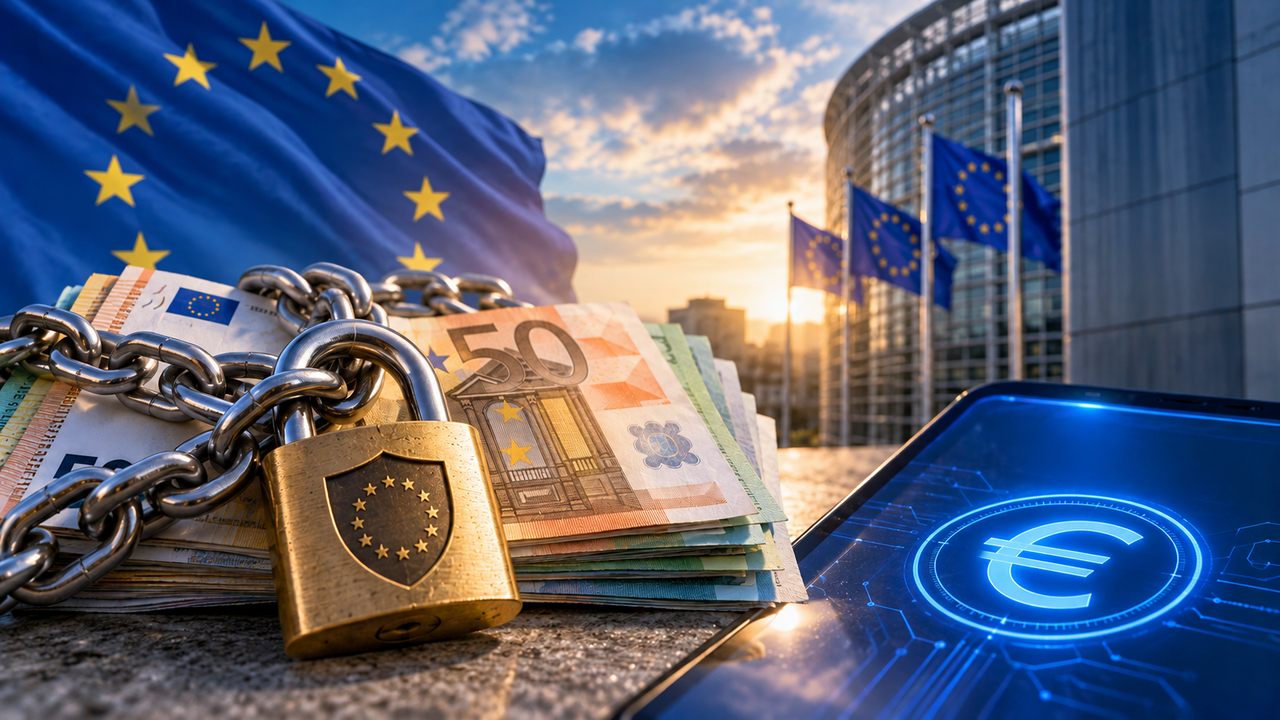
Save your savings
With the arrival of the digital euro and the fact that Ms Ursula von der Leyen, President of the European Union, announced on 27 August 2026 the terrible news that Europe was going to seize the savings of the European public in order to revive the European economy, all doors are now open to us.
Below you will find an explanation of what lies in store for Europeans.
It has been talked about for a long time, but today the digital euro is a reality and will be introduced between 1 January 2027 and 1 January 2029.
Until a few weeks ago, the European authorities had indicated that current accounts and savings accounts would be exempt, but this has changed following the statement by Ms Ursula von der Leyen, President of the European Union, on 27 August 2026.
Text of the speech by Ms Ursula von der Leyen, President of the European Union, on 27 August 2026:
But Europe has savings. Unfortunately, these savings are idle. 10,000 billion in household savings currently sit in bank deposits, and a significant proportion of European savings is invested outside our continent.
Europe must now put these savings to work for its businesses, and that is the aim of the Savings and Investment Union. We have put forward proposals on securitisation, on investments by banks and insurance companies, and on the integration of our markets and their supervision. Together, these could unlock up to 470 billion euros in additional investment.
2013 and 2015: Cyprus and Greece
We have already seen this scenario play out in Cyprus in 2013 and in Greece in 2015:
As part of a €10 billion international bailout, Cypriot banks were temporarily closed in March 2013 to prevent a run on the banks.
Deposits in excess of €100,000 held at the country’s two largest banks (Bank of Cyprus and Laiki Bank) were frozen and partially confiscated (in what is known as a ‘bail-in’) in order to restructure the banking sector.
In 2015, bank accounts and banks in Greece were frozen and closed. On 29 June 2015, the Greek government introduced capital controls to prevent a total collapse of the banking system following a massive run on the banks.
As a result, the banks remained completely closed for three weeks and Greek citizens were temporarily limited to withdrawing just 60 euros per day from their accounts.
It was not until 1 September 2019 that the very last restrictions on banking transactions in Greece were fully lifted.
The European Union’s seizure of savings will take place between 1 January 2027 and 1 January 2029, given that the EU’s proposal, spearheaded by Ms Ursula von der Leyen, will be submitted to the 27 Member States for their approval.
From 1st January 2027, the Commission may ban private transfers to a bank outside the European Union.
Countries such as Poland, Hungary and probably Poland will not sign this agreement, but all other countries will, given that the EU’s headquarters are based there.
Before the EU seizes your savings, there is a real risk that it will freeze savings accounts and passbooks to prevent you from putting your money in a safe place.
The only advice we give to savers is to move their money to safety as quickly as possible into an overseas account; this can be done very quickly and you are fully entitled to do so.
Our role is simply to introduce you to the bank by providing the necessary information. Following this introduction, your account will be opened within 10 days of all documents being submitted to the bank.
Please do not hesitate to contact us for further information, and do not forget: time is of the essence, as you risk losing your hard-earned savings.
The reason behind our work can be summed up in a single word: ‘Empathy’, because this is how, together, we ensure that European citizens’ savings remain safe for the rest of their lives and those of their children.
Please do not hesitate to contact us if you need more information.
Lees dit artikel red uw spaargeld in het Nederlands.